
Most North Vancouver homeowners approaching a fence project know they want cedar or vinyl, privacy or security, and a price that makes sense. What is less obvious before you start getting quotes is how much the North Shore’s specific conditions change the installation requirements compared to a flat, drier-climate project.
Slope, rainfall, soil type, and local bylaws all factor in. We see it often on North Vancouver jobs: the fence may look simple from the yard, but the details below grade and along the slope are what determine whether it stays straight.
This guide covers what fence installation in North Vancouver specifically requires, how to read a quote accurately, and what material choice makes the most sense for different North Shore property types.
North Vancouver properties, particularly in Lynn Valley, Edgemont, Upper Lonsdale, and the slopes below Grouse Mountain, frequently involve significant grade changes across a standard residential fence run.
Sloped installations require either stepped or raked panel layouts, taller posts on the uphill sections, and more detailed site measurement before materials are ordered. Getting this wrong at the planning stage results in misaligned panels, awkward gaps, or post heights that do not work once the fence is up.
Stepped fencing installs panels in horizontal increments that follow the grade down the slope. Each section drops by a set amount, creating a staircase profile. The result looks intentional and clean on most properties.
The trade-off is triangular gaps at the base of each step where the panel clears the ground. For yards where pet containment or child safety requires a fully closed base, stepped fencing needs a solution for those gaps – either additional infill at the base or a raked system instead.
Raked fencing angles continuously with the slope, with top and bottom rails following the grade rather than stepping. There are no base gaps, but the installation is more complex. Raked systems work cleanly with cedar boards, since each board can be cut to the required angle on site.
Pre-fabricated vinyl panels do not rake, which means a raked vinyl installation requires a custom approach rather than standard panel sections.
Post height planning on sloped lots is another variable that gets underestimated.
If the fence runs across a grade change of, say, 60 centimetres over 10 metres, the posts on the uphill sections need to be correspondingly taller to keep the fence at a consistent height. That affects material quantities and must be accounted for when ordering.
A contractor who does not measure the slope before quoting is essentially guessing the material list.
On one Upper Lonsdale project, the homeowner originally expected a standard six-foot privacy fence with identical panel sections. Once we measured the line, the grade change was too significant for standard panels to sit cleanly without leaving uneven gaps at the bottom.
We switched the layout to a stepped cedar fence with adjusted post heights and small base infill in the areas where the family dog could have slipped under. The finished fence still looked clean from the street, but the layout only worked because the slope was measured before materials were ordered.
That is the kind of detail that does not show up in a quick phone quote.
Cedar and vinyl are both well-suited to North Vancouver’s coastal climate when installed correctly. Cedar is the established choice for North Shore residential properties based on aesthetics, privacy, and longevity with proper maintenance.
Vinyl is the better choice for high-moisture exposure, shaded lots, and homeowners who want to eliminate ongoing maintenance. Chain link and aluminum serve specific applications where those materials’ properties outweigh their visual differences from cedar.
North Vancouver receives significantly more annual rainfall than Metro Vancouver’s flatter eastern suburbs. Environment and Climate Change Canada data indicates that North Vancouver’s Lynn Valley station averages over 2,000 mm of annual precipitation, roughly double what Richmond or Burnaby typically records. That precipitation level affects every material choice.
Environment and Climate Change Canada climate normals data indicates North Vancouver, Lynn Valley, annual precipitation averages approximately 2,100 mm, compared to Metro Vancouver averages closer to 1,100 to 1,400 mm in flatter eastern areas of the region. Source: climate.weather.gc.ca — verify current normals for the specific station.
Cedar performs well in these conditions with the right installation approach. The critical variables are post treatment, a properly sealed top cut on each post to prevent water entry, and good drainage at the footing base.
The biggest mistake we see is using standard cedar where pressure-treated ground-contact timber should have been used. In North Vancouver’s wetter soils, that can shorten the life of the fence dramatically.
Last spring, we replaced a cedar fence in Upper Lonsdale that was less than seven years old. The fence boards were still in good condition, and from a distance the fence did not look that old.
The problem was below grade.
The original installer had used untreated cedar posts in the ground. Several posts had rotted right at the soil line, causing the full fence line to lean even though the boards still had life left in them.
That is a common North Shore failure pattern. The visible part of the fence survives, but the support system gives out first.
Vinyl is increasingly the right answer for North Vancouver properties with shaded, low-drainage, or consistently wet backyard conditions. Commercial-grade vinyl with reinforced posts and solid core rails handles moisture, mould, and the kind of sustained wet exposure that accelerates cedar maintenance requirements in the worst-case North Shore microclimates.
Fine Fence’s cedar and vinyl installations both use commercial-grade materials — not the thinner-wall systems available at building supply retailers.
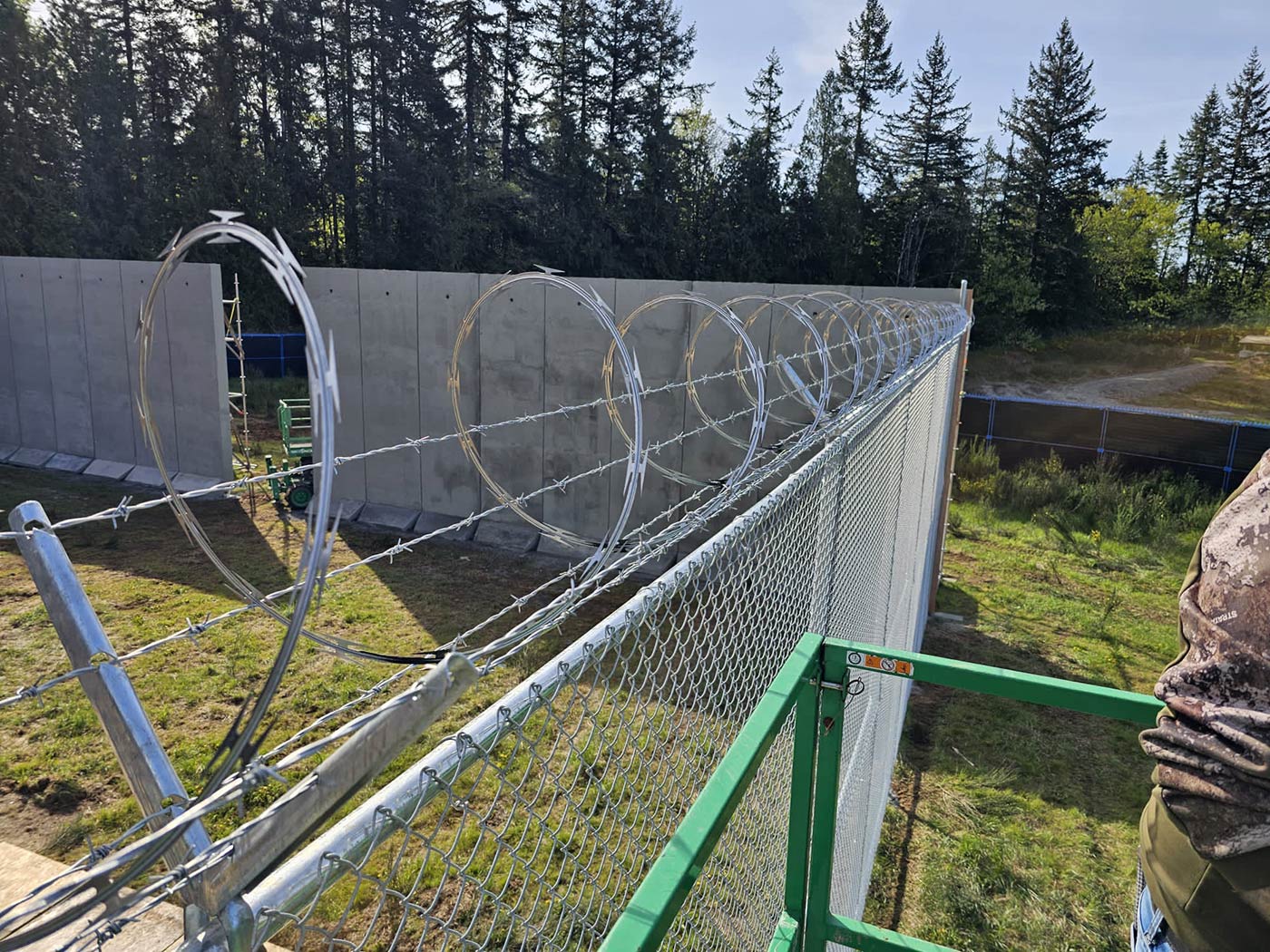
Chain link works well for North Vancouver properties where a large lot perimeter, secure containment, or commercial-grade security fencing is required. The open structure means wind loads pass through rather than applying lateral pressure to posts, which reduces stress on footings relative to solid privacy fencing in exposed hillside locations.
Galvanised or vinyl-coated chain link handles North Shore moisture without rusting. Fine Fence’s aluminum and metal fencing options suit front yard and commercial applications where a finished aesthetic matters alongside durability.
Fence height regulations in North Vancouver are set separately by the District of North Vancouver and the City of North Vancouver. Requirements differ between the two jurisdictions, and your specific address determines which applies.
Generally, rear and side yard fences up to approximately 1.83 metres do not require a permit in most residential zones, but front yard fences and corner lot placements have lower height limits and require verification before installation.
Corner lots in both jurisdictions are subject to sight triangle requirements near intersections. These restrict fence height within a specific area near the corner, typically measured from the intersection to maintain driver visibility.
Installing a privacy-height fence within a sight triangle without understanding those restrictions creates a compliance problem that may require fence removal or modification after the fact.
Permit requirements can also be triggered by fence placement on or near property lines where there is a slope or retaining structure involved. If a fence is being installed in conjunction with a retaining wall, the combined structure may trigger building permit requirements even if either element alone would not.
Fine Fence reviews applicable bylaw requirements during the site visit for every North Vancouver project and advises on what permits, if any, apply before work begins.
Compare written quotes that specify materials, post treatment level, post depth, footing specifications, and what is included in the workmanship warranty.
A single total price without those details gives you no basis for comparison and no record of what was promised if the installation falls short. The spread between the highest and lowest quotes for the same North Vancouver fence project is often explained by specification differences rather than contractor margin.
Three questions worth asking every contractor before accepting a quote:
A contractor who can answer all three specifically has thought about your project.
One who deflects or gives vague responses to the first question probably has not been to enough sloped North Shore lots to have a practised answer.
Fine Fence provides free on-site estimates for North Vancouver projects and a written quote with full material and installation specifications. Book a site visit or call +1 604-783-5079.
We have reviewed projects where two quotes looked similar on total price, but one used pressure-treated ground-contact posts and proper footing details while the other simply listed “cedar fence installation.”
Those are not the same quote.
On North Vancouver lots, especially where the soil stays wet or the fence line crosses a slope, the hidden details matter. Post depth, concrete footing size, drainage, gate hardware, and material grade all affect how the fence performs after the crew leaves.
A cheaper quote can still be fair, but only if the specifications are clear.
In most residential zones, rear and side yard fences at or below approximately 1.83 metres do not require a permit. Front yard fences and corner lot placements have lower height limits and are more likely to require permits or bylaw compliance review.
Always verify current requirements with the applicable municipality before installation. Fine Fence reviews this during the site visit for every North Vancouver project.
Fence installation costs in North Vancouver vary based on material, linear footage, slope complexity, and whether custom gate or retaining wall work is required.
Cedar with a stepped or raked layout is the most common approach on North Vancouver’s sloped residential lots. For properties where gap-free containment at the base is required, such as pets or children, raked cedar or a raked aluminum system works better than stepped panels.
Vinyl is generally installed stepped on sloped lots since pre-fabricated vinyl panels do not rake. The right choice depends on the degree of slope, the material, and what the fence needs to achieve.
An on-site assessment is the only accurate way to evaluate the options for a specific yard.
Standard residential fence installations in North Vancouver typically take 2 to 5 days for a 60 to 120 linear foot run on a straightforward lot, based on typical project timelines. Fine Fence provides a specific timeline estimate as part of the written quote after an on-site visit.
Yes. Fine Fence provides fence repair across North Vancouver for leaning or rotted posts, broken fence panels, storm-damaged sections, sagging gates, and rusted chain link.
A written assessment of repair versus full replacement is provided so property owners can evaluate both options with accurate cost information before deciding.
In many cases, targeted post replacement and panel repair extends the fence’s life by several years at a fraction of full replacement cost.
Yes. Fine Fence offers deck and retaining wall construction in addition to fencing across the Lower Mainland.
Spring and early summer are the busiest periods for residential fencing across the Lower Mainland. Booking 4 to 8 weeks in advance during peak season, from April through August, is advisable to secure a preferred start date. Outside peak season, lead times are generally shorter. Contact Fine Fence at +1 604-783-5079 to discuss current availability and book an on-site estimate.