
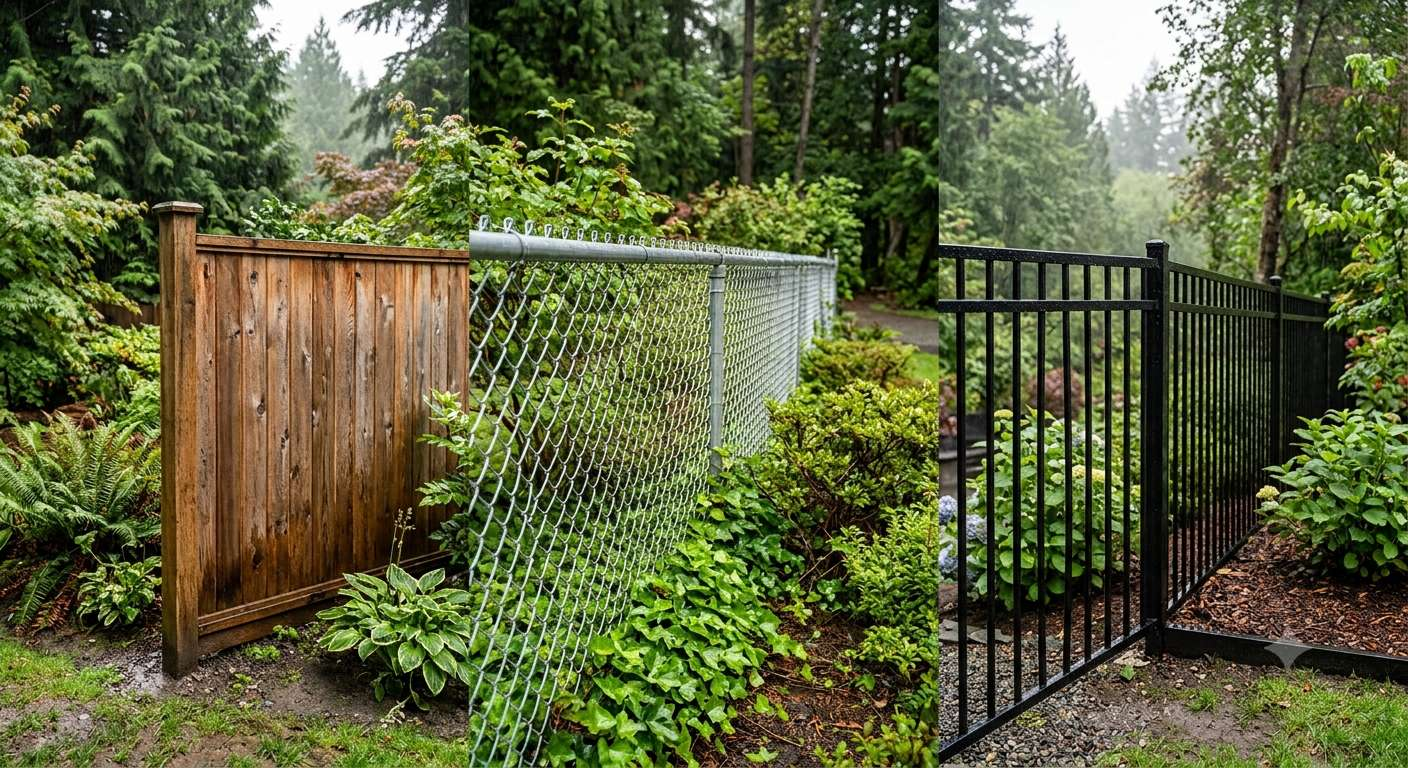
If you live in Vancouver and you’re choosing a fence material, the decision should start with one question your contractor may not ask: how much rain hits this specific part of your yard? That single factor, more than taste or budget, determines whether your fence looks good in five years or needs replacing in two.
We’ve installed fencing across the Lower Mainland long enough to see what survives and what doesn’t. Cedar, chain link, and metal each perform differently in Vancouver’s wet climate, and the right choice depends on your property type, your maintenance tolerance, and what the fence needs to do. This guide breaks down the three most popular materials by real-world performance in local conditions, not generic manufacturer claims.
Cedar is the best-performing wood option for Vancouver, hands down. Western Red Cedar carries natural oils that resist decay and repel insects without chemical pressure treatment, which matters when your fence faces more than 150 days of measurable precipitation a year in most of Metro Vancouver. The material breathes, meaning it absorbs and releases moisture without warping the way treated pine does.
That said, cedar is not maintenance-free. Without a protective stain or sealant applied every 2 to 3 years, cedar gradually greys from UV exposure and loses some of its surface resilience. We’ve seen fences in North Vancouver backyards stay beautiful for 15 years with regular sealing, and we’ve seen the same material split and rot in 4 years because nobody touched it after installation.
The failure point for cedar in Vancouver isn’t the panel. It’s the post. Posts set in Vancouver’s clay-heavy soil absorb ground moisture continuously, even during summer when the surface looks dry. If the post isn’t set deep enough, or if concrete pooling allows water to sit against the wood, rot starts underground where you can’t see it. The fence looks fine until the first October windstorm, and then it leans.
Expert Tip: We always recommend sealing cedar posts with an extra coat of wood preservative below grade before setting them in concrete. It takes 10 extra minutes per post and adds years to the fence’s life. Most contractors skip this step because the customer never sees it.
Common mistake: Homeowners often choose cedar because it looks natural and assume “natural” means “no maintenance.” Cedar needs a stain or clear sealer every 2 to 3 years. Without it, the same Vancouver rain that makes the city green will turn that warm cedar grey and eventually brittle.
Yes, for the right applications. Chain link is the most durable, lowest-maintenance fencing option available in Vancouver, and it outlasts every other material by years. The galvanized steel mesh doesn’t rot, doesn’t warp, and doesn’t care how much rain falls. A properly installed chain link fence can last 20 to 30 years with virtually no attention beyond occasional tightening.
Where chain link falls short is aesthetics and privacy. It offers visibility, not enclosure. For backyard privacy in a residential setting, cedar or vinyl is almost always the better choice. But for side yards, rental properties, commercial lots, school boundaries, and large properties where you need to define a perimeter without blocking light, chain link is hard to beat on cost or longevity.
Vinyl-coated chain link has changed the perception somewhat. Available in black, green, brown, and white, the vinyl coating adds corrosion resistance and a cleaner visual profile, letting the fence blend with landscaping rather than reading as industrial. In commercial settings across Metro Vancouver, the standard silver galvanized system remains the workhorse because it prioritizes function over appearance.
| Feature | Cedar | Chain Link | Metal (Aluminum) |
| Lifespan in Vancouver | 10 to 15 years (sealed) | 20 to 30 years | 20 to 25 years (powder-coated) |
| Maintenance | Stain every 2 to 3 years | Almost none | Wash annually, check powder coat |
| Privacy level | High | None | Low to medium |
| Price range | Mid to high | Lowest | High |
| Best for | Backyard privacy | Security, side yards, commercial | Front yards, modern homes |
| Rain performance | Good (natural oils) | Excellent (no rust on galvanized) | Very good (rust-resistant aluminum) |
Common mistake: We frequently see commercial property owners install chain link and then forget about the gate hardware. The mesh will outlast everything, but hinges, latches, and tension bars corrode in Vancouver’s salt-tinged coastal air. Budget for hardware replacement every 7 to 10 years, even if the mesh itself looks new.
Aluminum is the strongest metal option for Vancouver’s coastal climate. Unlike steel, aluminum doesn’t rust. It forms a thin oxide layer that actually protects the metal underneath, which makes it ideal for properties near the water or exposed to marine air along the Burrard Inlet. Powder-coated aluminum fencing maintains its finish for 15 to 20 years with minimal upkeep.
Steel fencing brings higher impact strength, which matters for commercial perimeters and industrial sites. But in Vancouver’s climate, steel needs proper powder coating and regular inspection. Any scratch that exposes bare steel will rust, and in a city where it rains every other day for eight months, that rust spreads faster than you’d expect. We’ve seen steel fences in industrial areas of South Vancouver develop rust blooms within a single wet season after coating damage.
For residential front yards, aluminum hits the sweet spot. It provides the clean, modern look that suits newer Vancouver homes without the maintenance burden of steel. The upfront cost is higher than chain link, and it doesn’t deliver privacy like cedar, but for a decorative boundary that defines the property line without blocking the architecture, aluminum is our go-to recommendation.
Expert Tip: If you’re choosing between steel and aluminum for a coastal property, ask your contractor what grade of powder coating they use. A cheap coating will peel in 3 years regardless of the metal underneath. Look for manufacturers that specify UV-resistant, marine-grade powder coating. The difference shows up the year after your first big winter storm.
Material choice matters, but in our experience, installation quality determines lifespan more than what you build with. Vancouver’s clay-heavy soil retains moisture year-round, which creates hydrostatic pressure against fence posts. On sloped properties across the North Shore and Coquitlam, that pressure combines with gravity to push posts out of plumb.
We’ve replaced hundreds of fence sections over the years where the material was fine but the installation was wrong. Posts set too shallow, concrete poured without drainage, or panels installed without accounting for the slope — each of these kills fences prematurely regardless of whether you chose cedar, chain link, or aluminum.
One scenario we see regularly: a homeowner in Coquitlam requests a cedar fence. The contractor sets posts 18 inches deep in concrete. Two wet seasons later, the clay soil has shifted, the concrete footing cracked from freeze-thaw, and the entire fence line leans 10 degrees. The cedar is still in great shape. The posts failed. The material wasn’t the problem. The installation depth was.
In Greater Vancouver, we set posts a minimum of 24 to 30 inches deep depending on soil conditions and fence height, with a gravel drainage layer beneath the concrete. On sloped lots, we step the fence panels to follow the grade rather than raking them, which prevents the bottom gaps that let pets and children slip through. These are details most homeowners don’t know to ask about, and they’re the difference between a 5-year fence and a 15-year fence.
| Property Type | Best Material | Why |
| Flat backyard, residential | Cedar | Privacy, natural beauty, good lifespan with sealing |
| Sloped lot, North Shore | Cedar or Metal | Both can be stepped; avoid panel systems that don’t flex |
| Commercial lot, flat | Chain link (galvanized) | Lowest cost per linear foot, maximum durability, zero privacy needed |
| Modern home, front yard | Aluminum | Clean lines, rust-proof, won’t block architecture |
| Rental property side yard | Chain link (vinyl-coated) | No maintenance by tenants, cost-effective, blends with landscaping |
| Industrial perimeter near coast | Aluminum or powder-coated steel | Aluminum for salt exposure; steel only with marine-grade coating |
Expert Tip: Before selecting a fence material, walk your property line after a heavy rain and look for standing water. If water pools along the fence route, no material will last its full lifespan. Address drainage first, then install. We have conversations about this with homeowners constantly, and the ones who fix drainage first save thousands in premature fence replacement.
For most Vancouver homeowners prioritizing backyard privacy, cedar remains our preferred material. No other option delivers the combination of natural beauty, privacy, and climate-appropriate performance that Western Red Cedar brings to a Lower Mainland property. The key is committing to a staining schedule every 2 to 3 years and working with a contractor who sets posts properly.
If your priority is security or you’re fencing a commercial property, chain link is the clear answer. It lasts longer than anything else, costs less upfront, and requires almost nothing from you except occasional gate hardware checks. Vinyl-coated chain link gives a cleaner look for visible areas without sacrificing the material’s core durability.
For modern homes where the fence defines a front property line, powder-coated aluminum is worth the investment. It won’t rust, won’t need resealing, and its clean profile complements the kind of architecture that defines newer Vancouver builds.
Whatever material you choose, invest in the installation. The best fence material in the world fails fast in Vancouver’s soil if the posts are set shallow. If you’re comparing quotes and one is significantly cheaper, ask what post depth they use, whether they add drainage gravel, and how they handle slopes. Those answers tell you more about the fence’s lifespan than the material itself.
Ready to start? If you’re planning a fencing project in Vancouver, Coquitlam, North Vancouver, or anywhere in the Lower Mainland, request a free estimate from a local team that understands the climate, the bylaws, and the soil. Visit https://finefence.ca/services/ or call 604-783-5079.
If you’re also considering a deck or retaining wall alongside your fence, our decks and retaining walls service builds outdoor structures that complement your new fencing. For properties with existing landscaping, our landscaping services help integrate the fence into your yard rather than dropping it as an afterthought. And if you’re on the North Shore where slope challenges are different, our North Vancouver fencing guide covers material selection for hillside properties specifically.
Most residential fence projects in Vancouver fall between $25 and $100 per linear foot, depending on material, height, gates, and site access conditions.
Yes. Cedar should be stained or sealed every 2 to 3 years to protect against UV greying and surface moisture, though it will still resist decay without it.
Galvanized chain link typically lasts 20 to 30 years with minimal maintenance, making it the longest-lasting fence material available locally.
No. Aluminum forms a protective oxide layer that prevents rust, making it ideal for properties near the water or exposed to marine air.
We recommend a minimum of 24 to 30 inches deep depending on fence height and soil type, with a gravel drainage layer beneath the concrete.
Yes. We step fence panels to follow the grade, which looks cleaner and prevents bottom gaps. Raked panels are possible on gentle slopes.
Vinyl (PVC) fencing is an option for low-maintenance residential applications. It won’t rot or need sealing, but it can become brittle in sustained cold and doesn’t offer the natural look of cedar or the longevity of aluminum. We’re happy to discuss it as part of a free estimate if it’s on your shortlist.
Yes, every installation carries a 36-month limited workmanship warranty, alongside full liability insurance and WCB clearance.